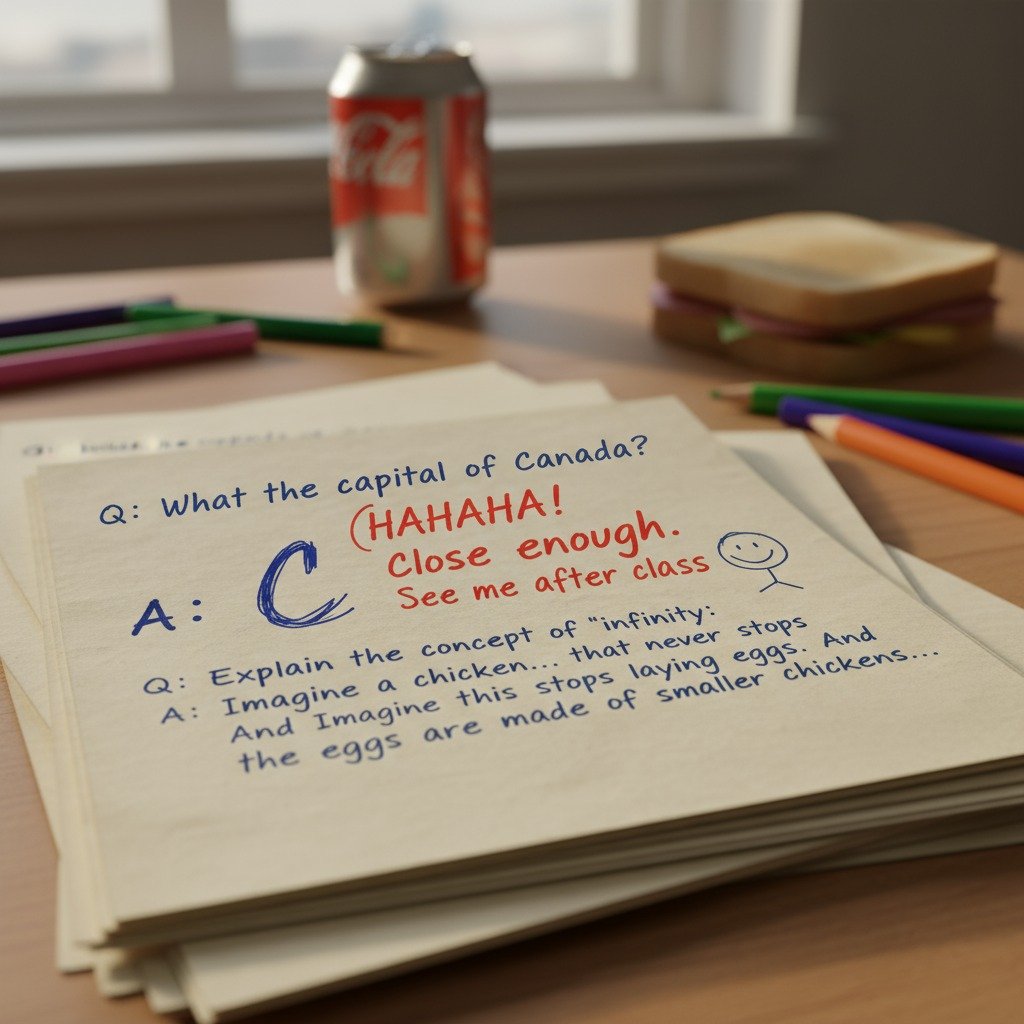
Exams are meant to test knowledge, logic, and problem-solving. Yet every now and then, the result is something completely different — a laugh-out-loud moment born out of human error, clever misinterpretation, or the pure chaos of language. These moments are what the internet lovingly calls hilarious test questions. Whether it’s a student who answers with unshakable confidence in nonsense, or a teacher whose typo changes the entire meaning of a question, these snippets of educational mischief have become small gems of comedy that never fail to spread joy.
Over the past decade, social media has become a digital scrapbook for these unintentional treasures. Shared across platforms like Reddit, Twitter, and TikTok, hilarious test questions tap into a universal experience: the mix of stress, confusion, and occasional creativity that learning brings. They don’t just make us laugh — they remind us that even in the most structured environments, humanity and humor sneak in. This article explores how these funny test mishaps happen, why they captivate millions online, and what they reveal about the human side of education.
The Accidental Genius Behind Hilarious Test Questions
Let’s start with the source: the sheer unpredictability of human expression. Most hilarious test questions begin with a simple misunderstanding — a phrase used in an unexpected way, a math problem that invites an accidental pun, or a question that wasn’t proofread as carefully as it should have been. Suddenly, what was meant to be serious becomes a piece of unintentional comedy.
Sometimes, the humor lies not in the question itself, but in the response. A classic example is when students take an overly literal approach: asked to “name the quadrilateral,” one writes “Bob.” Or when an open-ended prompt inspires creativity beyond the teacher’s intentions. There’s a certain charm in seeing how young minds interpret logic through their own lenses. It’s not mockery; rather, it’s a warm reminder that thinking differently can lead to delightful surprises.
Errors made by teachers or exam systems also play a role. A misplaced decimal, a misused word, or an ambiguous phrase can completely alter a question’s meaning. Such slips expose how fragile clarity can be under pressure. And when that fragility meets bright imagination — well, hilarity ensues. These moments show that education, for all its seriousness, thrives on shared imperfection.
From a linguistic point of view, these examples also highlight the beauty of semantic play. Ambiguity is the soul of humor — a phrase that can hold multiple meanings gives the mind room to dance. That subtle overlap between meaning and misunderstanding is exactly what fuels most hilarious test questions.
Why We Can’t Stop Sharing Funny Exam Questions Online
In a world flooded with information, what cuts through is human emotion — laughter, nostalgia, and connection. Hilarious test questions hit all those notes perfectly. When people encounter a picture of a misspelled test question or a student’s clever answer online, they experience a spark of recognition: I’ve been there. We all remember that moment of staring at an impossible question, unsure whether to cry or laugh. The humor functions as a kind of emotional release from the pressure that exams create.
Sharing these moments online also plays into the culture of collective participation. Every repost, retweet, and comment reflects a shared understanding of educational struggle. Parents, teachers, students, and even employers — everyone has played some part in the testing ritual, and everyone can appreciate its occasional absurdity. This universality gives hilarious test questions viral potential. They embody situations that transcend language or background, reminding people everywhere that learning is a messy, human process.
Psychologically, sharing humor is a form of connection. Funny exam questions become tiny vehicles of empathy. The person posting them is saying, “See? We all make mistakes,” while the audience responds with laughter that bonds rather than divides. In an online landscape filled with pressure, outrage, and polished perfection, these snippets of academic comedy restore authenticity. That’s why they endure: because they merge relatability with simplicity.
Real-Life Examples That Prove Tests Can Be Comedic Gold
Nothing captures attention like real (and real-world) examples. Across classrooms globally, teachers have stories of test questions that went viral for their humor. Imagine a biology quiz asking, “Name one organ found in the human body,” and a student confidently writing, “The church organ.” Or a geography exam misprinted to read, “What is the main cause of holes in the ozone layer? (Tick one box)” — and the boxes say “Cows / Politicians / The moon.”
These real-life moments happen for countless reasons. Some reflect the elasticity of language — one word accidentally replaced changes the entire question’s tone. Others reveal unexpected creativity from test-takers who find humor in difficult situations. What makes them so widely loved is not the mistake itself, but the joy it brings afterward. Each hilarious test question tells a story of someone thinking differently, sometimes mischievously, sometimes sincerely.
It’s also worth noting that these examples are a form of living folklore in education. Teachers collect them like souvenirs of human ingenuity, sharing them in staff rooms or end-of-year gatherings. Students remember them years later because they transformed a stressful environment into something momentarily joyful. At their best, these moments blend education with entertainment — what some educators call “edutainment” in its most natural form.
The Psychology Of What Makes A Test Question Hilarious
Why do hilarious test questions—despite being small moments—delight us so much? Humor in this context comes from surprise. In psychology, laughter often arises when we recognize an incongruity: something appears perfectly logical but turns out unexpectedly absurd. A student writing “42” for every answer may not be right, but the boldness triggers that pleasant shock our brain interprets as funny.
Timing and shared experience add more layers. Everyone recalls test anxiety, the long silence of a classroom, and the sudden mental blank. Against that background, humor sparkles even brighter. In these situations, laughter acts as tension relief. It acknowledges the stress while softening it. Teachers laugh because it humanizes their profession; students laugh because it validates that learning is not purely mechanical.
Linguistically, funny test moments often hinge on the dual meanings of words — a semantic overlap that messes delightfully with our expectations. This is where semantic SEO becomes a helpful analogy. Just as Google learns to understand context beyond single keywords, our brains understand humor by connecting multiple layers of meaning. The human mind doesn’t isolate phrases; it interprets intent, nuance, and surprise. That’s why optimizing content for people, not algorithms, now mirrors how humor itself works — guided by emotion and context, not formula.
How Teachers And Students Embrace The Funny Side Of Exams
Despite the traditional seriousness of education, humor has always found its way into the classroom. Teachers with a sense of humor often note how laughter helps build rapport and ease anxiety. When a test question turns out to be hilariously phrased, good educators often laugh first, then use it as a teaching opportunity to talk about clarity, critical thinking, or even grammar. It’s a reminder that perfection isn’t the goal — comprehension is.
Students, on their part, embrace this lighter side of learning as a form of creativity. Their witty answers, drawn from imagination or sheer panic, demonstrate flexible thinking — something modern education systems increasingly value. Many teachers even incorporate intentionally funny prompts to encourage engagement. After all, a smiling student absorbs knowledge faster than a nervous one.
This partnership between humor and education reinforces a vital truth: laughter improves learning outcomes. Studies in educational psychology show that humor enhances memory retention, boosts participation, and lowers stress levels. So while “hilarious test questions” may sound like mere internet fluff, they have genuine pedagogical value. They show that joy and learning are not opposites but allies.
Conclusion
At their heart, hilarious test questions remind us that education is a human endeavor — imperfect, unpredictable, and sometimes unbelievably funny. They reveal the beautiful intersection of curiosity and chaos, where structure meets spontaneity. Each laugh they provoke breaks down the invisible wall between student and teacher, rule and reality.
These moments also tell a larger story about how we share knowledge. In an age where artificial intelligence curates the web, it’s reassuring to know that what trends most are the things that feel real: fragile handwriting, unexpected wordplay, honest human error. In that sense, hilarious test questions aren’t just a passing meme — they’re proof that humor still binds us in the great experiment of learning.
FAQ’s:
What Exactly Are “Hilarious Test Questions”?
Hilarious test questions are exam or quiz prompts — or sometimes students’ responses — that turn out to be unintentionally funny. The humor often comes from typos, ambiguous wording, creative answers, or simple miscommunication between student and teacher.
Why Do Hilarious Test Questions Go Viral Online?
They spread quickly because they strike a universal chord — everyone’s faced confusing questions or exam stress. When those stressful moments turn silly, it creates instant connection and laughter. The humor is relatable, harmless, and often surprising, which makes people want to share it.
Are Hilarious Test Questions Staged Or Real?
Most of them come from real exams collected by teachers or students, though some shared online are slight exaggerations or classroom jokes. The truly funny ones tend to come from genuine classroom moments where creativity meets confusion.
Do Teachers Enjoy Spotting Hilarious Test Questions?
Yes — many educators find them endearing. Instead of frustration, teachers often treat such moments as reminders that learning is a deeply human process. Some even keep collections of the funniest answers as lighthearted memories of their teaching careers.
Can Humor Actually Help Students Learn Better?
Absolutely. Research in educational psychology shows that humor reduces anxiety, boosts memory, and encourages participation. Laughing at or about a funny exam question helps students relax — and a relaxed mind retains information more effectively.
Hungry for more? Head over to my website for fresh articles.
10 Simple Reasons Coffee Lovers Are Switching To Skinny Roast In 2025
Disclaimer:
This article is for general informational and entertainment purposes only and does not replace professional educational or psychological advice. Humor and examples of hilarious test questions may vary based on individual experiences, teaching styles, and cultural context. Always approach educational humor with respect and use discretion when sharing content in academic or professional settings.
